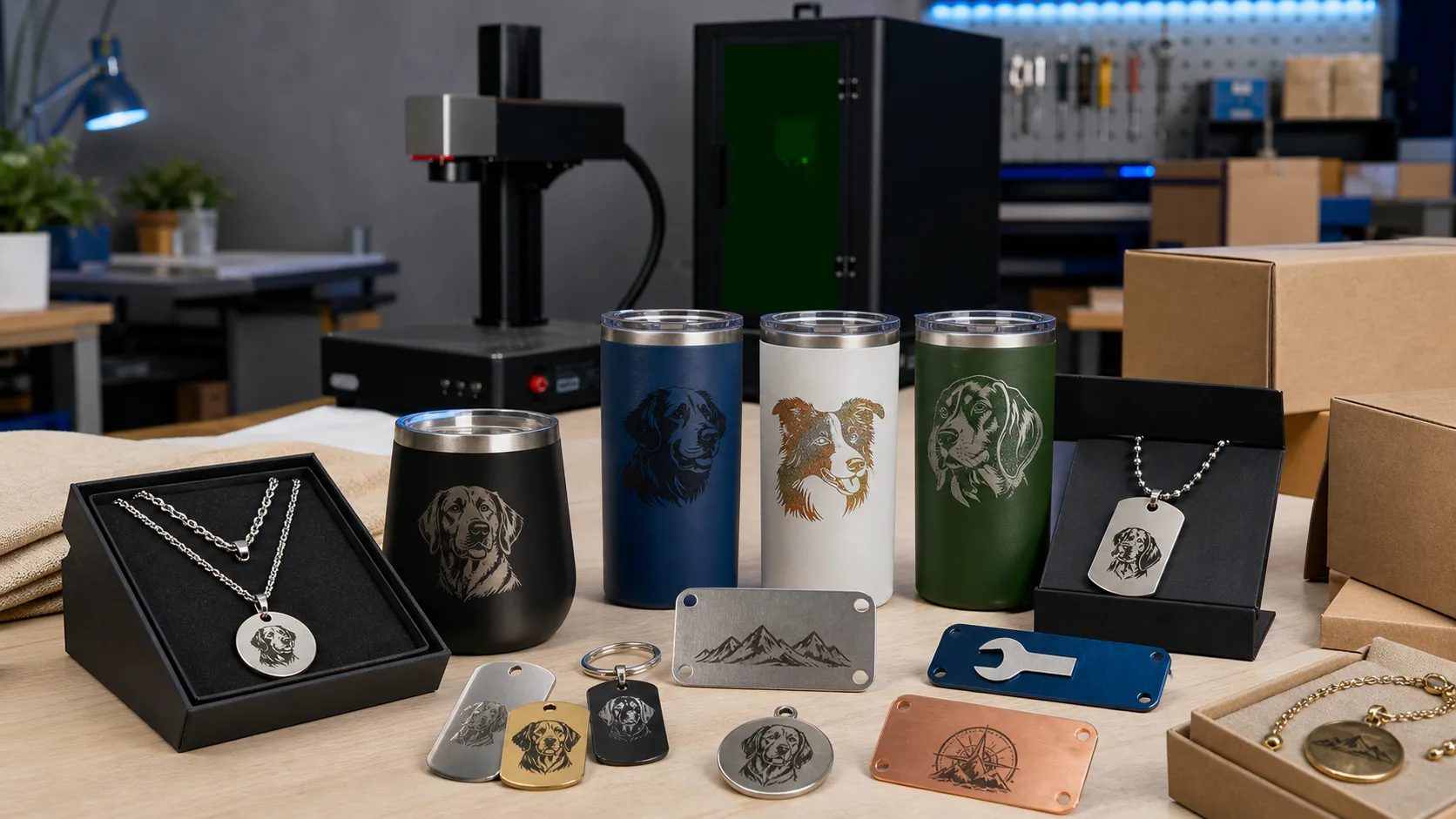
If you are shopping for a metal-marking machine, product listings can make "fiber laser" and "MOPA laser" sound like two separate laser families. They are not: MOPA is also a fiber laser. For desktop metal marking, the useful comparison is usually a Q-switched fiber laser with fixed pulse behavior versus a nanosecond MOPA fiber laser with adjustable pulse settings.
This article uses Q-switched fiber laser for the conventional fixed-pulse class commonly compared with MOPA in the desktop marking market. That shorthand does not mean every non-MOPA fiber laser in every industry is Q-switched. Here, MOPA means the adjustable-pulse nanosecond marking sources used in this product category. The broader MOPA oscillator-amplifier architecture does not guarantee adjustable pulse control in every laser application.
For routine black-and-white marking, identification, and engraving, a Q-switched laser may cover the work with fewer settings to manage. MOPA is worth considering when adjustable pulse behavior supports finishes you intend to sell, such as tested color marking on compatible stainless steel or dark marking on anodized aluminum. Test the exact material, finish, lens, focus, and settings before promising a result to a customer.
First, MOPA is still a fiber laser
"Fiber" describes the wider laser family. In a pulsed fiber marking system, the laser source, scanning head, and focusing lens work together to place short pulses of energy on a material. Fiber sources operating around one micrometer are widely used for metals because that wavelength is well matched to the absorption characteristics of many metals. Coherent's laser-marking overview identifies Q-switched and MOPA as the two main variants of pulsed fiber markers.
Why do sellers often list one machine as "Fiber" and another as "MOPA"? Desktop-machine listings reviewed for this article suggest a useful market rule of thumb: a marker advertised only as a fiber laser often uses a conventional fixed-pulse or Q-switched source, while an adjustable-pulse MOPA source is named explicitly. This is sales shorthand, not a universal technical definition. Ask the seller: Is the pulse width fixed or adjustable, and what source architecture is installed? We use the same customer-facing distinction in our Promark Safe+ series comparison, labeling one option "Fiber Laser" and the other "MOPA Laser."
How a Q-switched fiber laser works
A Q-switched laser first stores energy in its gain medium while the optical cavity is kept in a high-loss state, which prevents normal laser output. When the cavity switches to a low-loss state, the stored energy is released as a short, intense pulse. Newport's explanation of Q-switching describes this energy-storage-and-release process in more detail.
For the operator, the exact relationship among repetition rate, pulse duration, pulse shape, pulse energy, and peak power is source-specific. On many conventional Q-switched marking sources, those characteristics are more tightly linked. You can still adjust power, speed, frequency, hatch spacing, focus, and other job settings, but you usually have fewer independent pulse controls than with the adjustable-pulse MOPA markers discussed here.
When that smaller tuning range covers the finishes you sell, it can simplify production and make repeatable settings easier to build for routine jobs such as:
- serial numbers, barcodes, logos, and identification marks;
- black-and-white contrast marking on suitable metals and plastics;
- engraving that removes material;
- production work where the material and desired finish stay consistent.
How a MOPA fiber laser works
MOPA stands for Master Oscillator Power Amplifier. The master oscillator creates a low-power "seed" signal with selected characteristics. A separate power-amplifier stage then increases that signal's power while preserving the qualities established by the oscillator. That two-stage principle is summarized in Coherent's MOPA technology overview.
In the adjustable-pulse nanosecond marking sources discussed here, the operator can select pulse duration and related pulse characteristics with greater independence from repetition frequency, within the range supported by that specific source. A useful analogy is a camera: a Q-switched source behaves more like a dependable preset, while adjustable-pulse MOPA adds manual controls. Those controls expand what you can tune, but they do not automatically make a job faster or better.
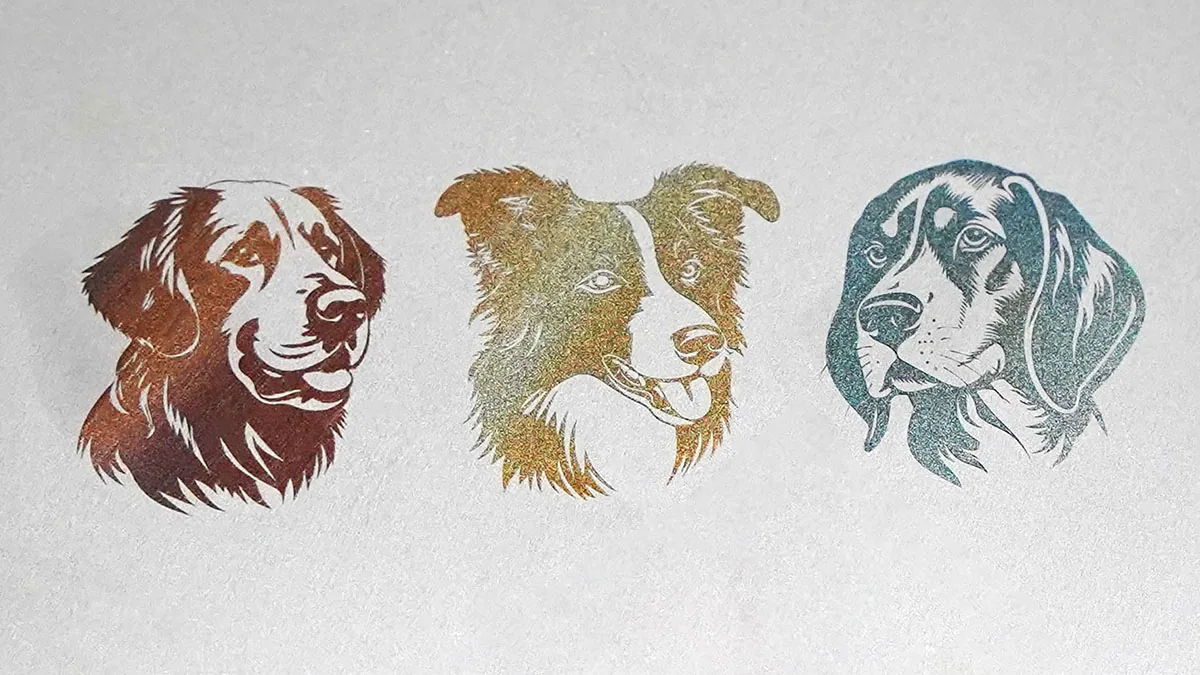
The extra control matters when the result depends strongly on how energy is delivered rather than only on average power. Research on MOPA color marking of stainless steel links visible color to laser-controlled surface oxide-layer thickness and the resulting thin-film effect. Our MOPA color process uses adjustable pulse width and frequency, and our color-marking guide notes that color is sensitive to the material, focus, power control, and testing. Color marking is a controlled process, not a promise that every metal will produce every color.
MOPA vs. Q-switched fiber laser
| Decision factor | Q-switched fiber laser | Adjustable-pulse MOPA fiber |
|---|---|---|
| Laser family | Pulsed fiber laser | Pulsed fiber laser |
| Basic pulse behavior | Pulse width, shape, and peak power are typically functions of repetition frequency. | Pulse duration and related characteristics can be selected with greater independence from frequency within the source's supported range. |
| Learning curve | A smaller parameter space can be easier to standardize. | More control creates more combinations to test and document. |
| Common strengths | Routine black-and-white marking, identification, and engraving. | Those same jobs plus dark marking on anodized aluminum and color marking on stainless steel demonstrated with Promark MOPA; selected plastics may also benefit. |
| Color marking | Unstable color results, not suitable | Color results are relatively stable; but needs to be calibrated every day for different materials. |
| Best business fit | A focused catalog with repeatable materials and finishes. | A broader catalog where tested finish variety supports differentiated customization. |
The technical rows summarize Coherent's pulsed-fiber comparison and our current Promark comparison. The workflow and business-fit rows are practical guidance based on those sources. Actual cycle time and results depend on the job and machine configuration, so the source label alone does not predict engraving speed or depth.
Pros and cons
Q-switched fiber laser: pros
- Potentially simpler production setup. Fewer independent pulse controls can make operator training and a settings library easier to manage.
- Strong fit for repeatable marking work. It is well suited to logos, identifiers, black-and-white marks, and engraving on compatible materials.
- Mature fiber-laser benefits. Laser marking is non-contact, creates permanent marks, and does not require inks or marking-tool consumables, according to Coherent's laser-marking guide.
Q-switched fiber laser: cons
- Less independent pulse control. Q-switched pulse width, shape, and peak power are typically more closely coupled to repetition frequency.
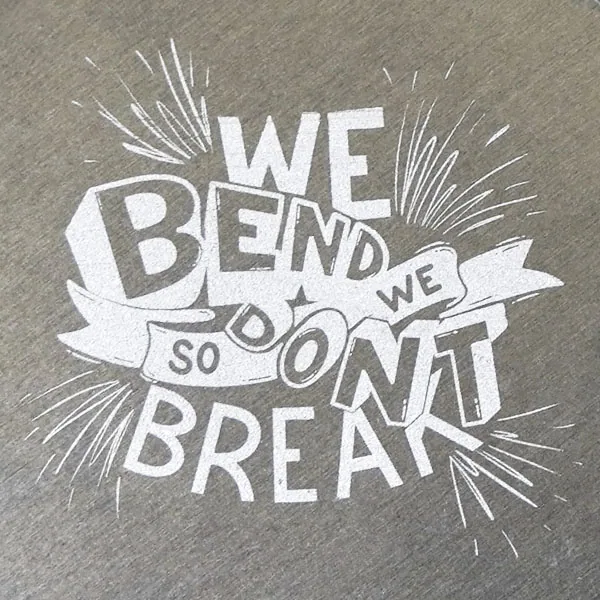
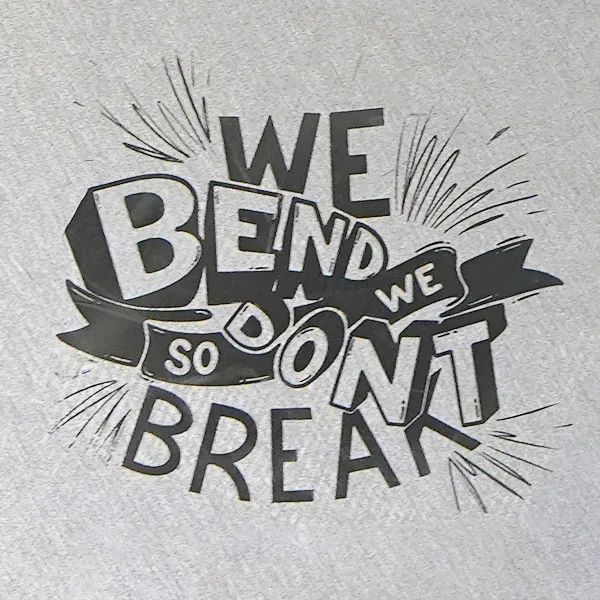
- Fewer demonstrated finish options in our comparison. Our Promark comparison shows a light-colored result on anodized aluminum with Promark Desktop and less-stable color output than Promark MOPA.
- The label can be vague. A listing that says only "fiber laser" does not tell you enough. Confirm the source type and pulse controls before buying.
MOPA fiber laser: pros
- More adjustable pulse behavior. Within the source's supported range, operators have more ways to tune pulse duration and related characteristics for a tested result.
- Broader demonstrated finish potential. Our Promark MOPA examples include a dark result on anodized aluminum, color marking on stainless steel, and comparatively better plastic marking. Results remain material- and settings-specific.
- Room for differentiated services. A documented library of tested finishes can set a service apart when those additional options match customer demand.
MOPA fiber laser: cons
- More recipes to validate. More parameter combinations mean more recipes to test and document for your actual stock.
- Color is sensitive. Our guide notes that changes in focus, power control, or material properties can shift the result, so sample testing matters.
- Production discipline still matters. In practice, added pulse control does not replace good fixturing, focus control, artwork preparation, safe operation, or quality checks.
Which one makes more sense for a customization business?
Start with the products you expect to sell, not the longest specification sheet.
Choose a Q-switched laser when
- most orders are names, logos, identifiers, or black-and-white graphics;
- you plan to engrave a stable set of metals and coated products;
- deep engraving and routine production matter more than color experimentation;
- you want a smaller settings library that is easier to train and repeat.
Choose MOPA when
- dark marking on anodized aluminum is central to your catalog;
- color marking on tested, compatible stainless steel can support differentiated products;
- adjustable pulse duration is important to the tested finish;
- you are willing to spend time building and maintaining material-specific recipes.
Compare the finishes customers will buy, setup time, and reject rate. Before accepting a large order, test the customer's actual material and finish, record the complete parameter set, and retain an approved reference piece.
Laser safety depends on accessible emission from the complete product configuration, not on whether the source is labeled Q-switched or MOPA. IEC 60825-1 classifies laser products according to optical-radiation hazard and accessible emission, including lasers incorporated into larger optical, electrical, or mechanical systems. OSHA states that Class 4 products can present immediate eye and skin hazards from direct or reflected beams and may also present a fire hazard. Follow the exact machine manual and applicable local requirements, and never defeat an enclosure or interlock.
Meet Promark Desktop and Promark MOPA
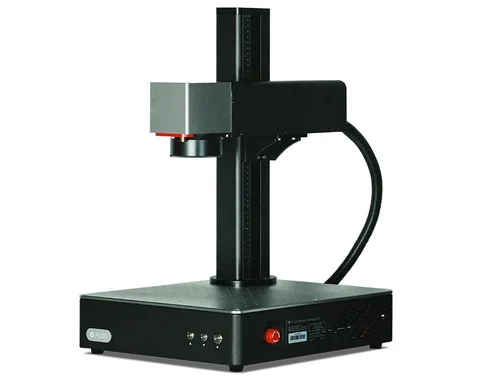
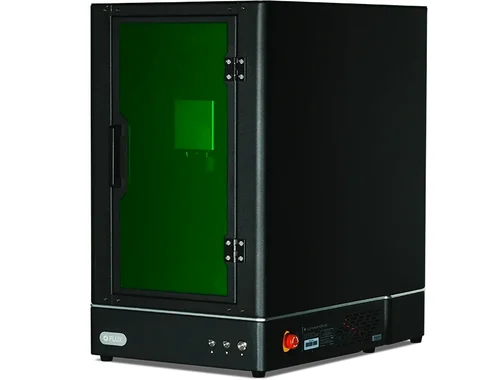
For desktop buyers, our Promark series offers two laser-source paths: Promark Desktop and Promark MOPA.
Promark Desktop
Promark Desktop is our fixed-pulse fiber option for black-and-white marking and deep engraving. Our comparison also shows a light-colored result on anodized aluminum. It is a practical starting point for logos, identification, jewelry engraving, tools, tags, and repeatable monochrome customization, provided sample tests meet the required finish.
Promark MOPA
Promark MOPA adds selectable pulse-width settings for black-and-white marking and deep engraving, relatively more stable color marking on supported materials, and dark marking on anodized aluminum. Our current Promark MOPA Safe+ comparison lists both Promark Desktop and Promark MOPA at a 1064 nm wavelength. The distinction is pulse control, not a separate laser family.
Exact available power, work area, pulse range, enclosure, and accessories can vary by model and sales region. Confirm the current configuration with our team or your local reseller, and test the materials that matter to your business.
Compare the Promark series
Ready to match the laser source to the products you want to sell? Compare Promark Desktop and Promark MOPA, then prepare a short list of your materials, target finishes, expected order sizes, and sample files for a practical evaluation.